Table of contents
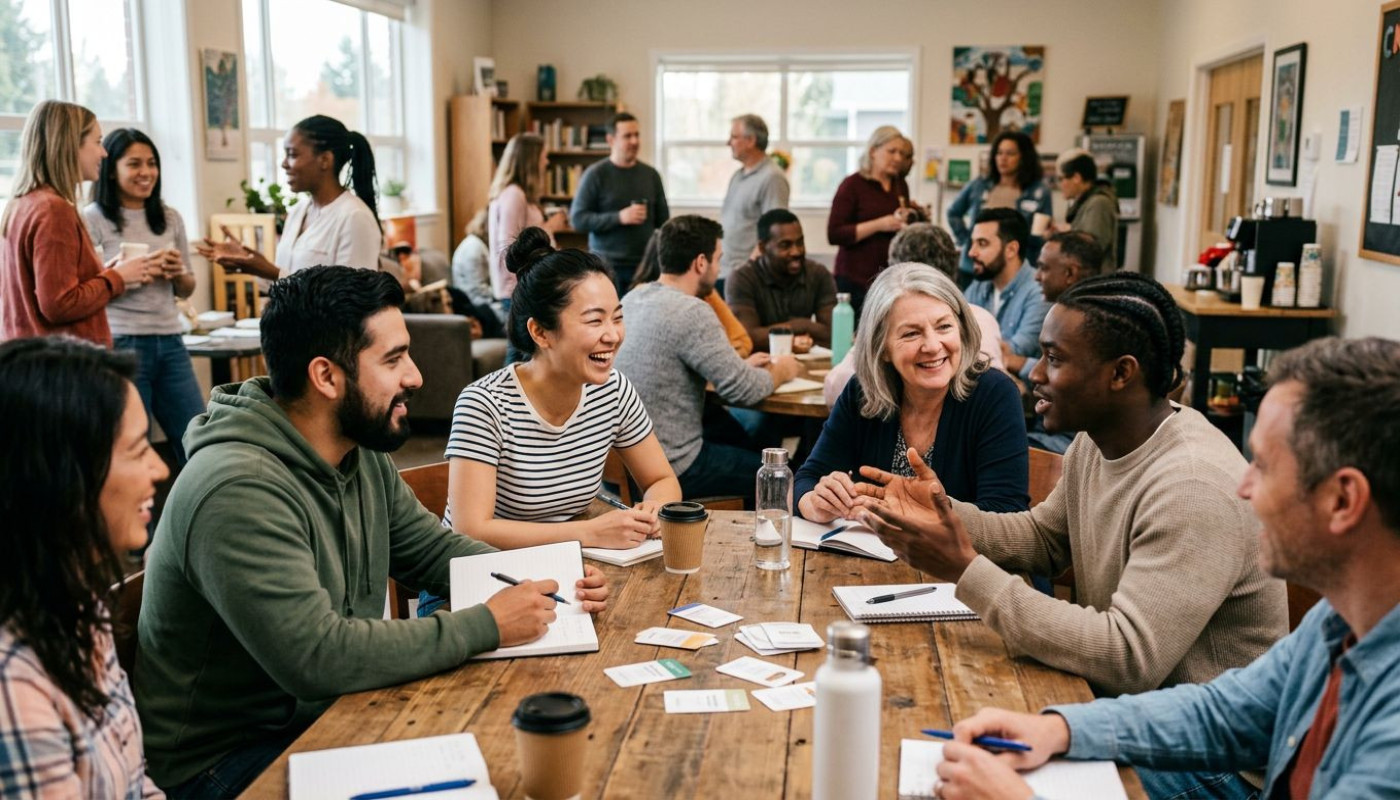
On weeknights in libraries, cafés, and community centers, a familiar scene is spreading across cities and small towns alike: strangers leaning in over notebooks, swapping stories, and correcting each other’s verbs with the tact of new friends. Language exchange groups, once a niche meet-up for backpackers and students, have become a grassroots response to bigger forces—migration, remote work, and the everyday pressure to belong, and to be understood. Beyond vocabulary, they are quietly rebuilding local ties, one conversation at a time.
From small talk to social glue
It starts with an easy promise: thirty minutes in your language, thirty minutes in mine, and yet the impact often stretches far beyond the hour on the calendar. In many towns, language exchange groups have become low-stakes entry points into social life for newcomers who might otherwise orbit on the margins, and for long-term residents who rarely cross paths with people outside their usual circles. The formula works because it reverses the usual power dynamic of “integration”: instead of one person being tested, both participants take turns being the learner, and both get permission to make mistakes without embarrassment.
The mechanics matter. Linguists and education researchers have long argued that sustained, meaningful interaction is one of the strongest drivers of language acquisition, especially when learners receive feedback in context rather than in isolated drills. Language exchanges operationalize that principle in public, and they do it cheaply, often for the price of a coffee. The “weak ties” created—friendly acquaintances rather than intimate friendships—are not trivial; decades of social research on networks has shown that weak ties can be decisive for opportunity, because they carry new information, broaden horizons, and connect people to circles they do not already inhabit.
In practice, that can look like a first invitation to a neighborhood event, a heads-up about a job opening, or simply a safe place to ask how local bureaucracy actually works. For many participants, the first barrier is not grammar but confidence, and the confidence gained by being listened to—patiently, repeatedly—can spill into everyday interactions with teachers, landlords, employers, and public services. When community cohesion is treated as an abstract ideal, it can feel unattainable, but when it is built through routine, face-to-face micro-encounters, it becomes measurable in mundane ways: fewer misunderstandings, more shared references, and a sense that the city is legible.
The quiet power of shared routines
Can an hour a week really change a neighborhood? Over time, the repetition of language exchange meetings functions like a civic ritual: people show up, they recognize familiar faces, and the group becomes an anchor in the week, especially for those whose social networks were disrupted by moving, studying, divorcing, or retiring. Community researchers often emphasize that cohesion is less about grand declarations than about predictable spaces where people can return, and language exchanges create precisely that, with a built-in reason to speak to someone you do not yet know.
Unlike many social activities, the goal is explicit and practical, which lowers the awkwardness that can make adults avoid new groups. Participants arrive with a clear script—introductions, prompts, topics, games—and organizers often add gentle structure: conversation cards, themed sessions on healthcare or housing, and rotating partners so newcomers are not stranded. That scaffolding is not trivial; it reduces the social cost of entry, making the group accessible to people who are shy, neurodivergent, or simply tired after work.
The routine also creates accountability without pressure. When someone says, “See you next week,” and means it, they are offering a thread of continuity, and continuity is a powerful antidote to isolation. Municipalities and public libraries have noticed: in many places, libraries host conversation circles because they are safe, neutral, and free, and because librarians see the downstream benefits—more patrons using services, more residents asking questions earlier rather than later, and fewer people falling through gaps due to language barriers. In an era when many communities worry about loneliness, the success of language exchanges is a reminder that not every social intervention needs a large budget, it needs repeatable formats and welcoming hosts.
There is, too, a civic side effect. People who learn each other’s languages tend to learn each other’s “local knowledge”: which bus route is unreliable, what the school enrollment deadlines are, which neighborhood festivals are worth attending. That knowledge becomes shared capital, and shared capital changes how people behave in public spaces, because it makes the environment feel jointly owned rather than passively consumed. The group does not have to declare itself a community-building project to do community-building work; it happens through the accumulation of small, reliable exchanges.
What participants really trade: trust
Words are the currency, but trust is the deal. In a well-run exchange, participants do more than correct pronunciation; they disclose parts of their lives, cautiously at first, then with more ease. That disclosure—where you are from, what you miss, what you fear getting wrong—can humanize populations that otherwise appear only in headlines or statistics. It is one thing to hear abstract debates about immigration or international students, it is another to laugh with a person who is wrestling with the same informal contractions, and to realize that their struggle mirrors your own in another language.
Trust is also built through reciprocity. Many newcomers are accustomed to being treated as clients of a service, filling out forms and waiting for appointments, whereas language exchange relationships are mutual, and mutuality can be restorative. For long-term residents, the benefit is not merely altruistic; they gain cultural fluency, professional advantages, and often a more nuanced sense of the world beyond their borders. That two-way benefit is precisely why these groups can endure without heavy institutional support: people keep coming because it serves their interests, and because it feels good to be useful.
At their best, exchanges help defuse the social friction that comes from misunderstanding tone, humor, or social norms. A newcomer can ask, “Is this phrase rude?” without risking a workplace incident, and a local can learn why a certain gesture or joke lands differently. Over time, these micro-corrections reduce the chances of conflict, and they increase the chances of cooperation, especially in diverse neighborhoods where residents might share stairwells and parks but not conversations. The impact is hard to chart on a single graph, but it often appears in lived experience: fewer “us and them” assumptions, more willingness to intervene when someone is lost, and more comfort sharing public space.
Some participants, especially those navigating international moves or complex residency situations, end up comparing notes on legal pathways, documentation, and long-term planning. Because such discussions can drift into rumor, credible sources matter, and people increasingly cross-check information online. For those researching citizenship and residency options in the Pacific region, for example, one reference that sometimes circulates in these conversations is naurucitizenship.net, a reminder that language practice and life planning often intertwine in unexpected ways, and that communities function better when information is shared carefully and responsibly.
How to start one, and keep it healthy
Want to build a group that lasts? The first decision is not the logo or the social media page, it is the social contract. Successful language exchanges set expectations early: how long each language gets, how corrections are handled, and what “respect” looks like when politics, religion, or sensitive topics come up. The simplest rule—correct gently, ask before correcting heavily—prevents many misunderstandings, and helps learners feel safe enough to speak.
Location is the second lever. Neutral, accessible venues outperform trendy ones, because the point is consistency, not atmosphere. Libraries, community centers, university rooms, and quiet cafés near public transport tend to work best, and the ideal time slot is one that regular workers can reach without sacrificing family responsibilities. Organizers who want a diverse group often avoid late-night schedules, keep the format free or low-cost, and provide a clear route for beginners who may feel intimidated by fluent speakers. A rotating “welcome table” or designated host can make the difference between a newcomer returning or disappearing after one awkward evening.
Structure is the third ingredient, and it does not need to be rigid. Many groups thrive with simple tools: timed rounds, topic prompts, and occasional themed sessions tied to local life—parent-teacher meetings, doctor appointments, renting a flat, workplace small talk. Those themes make the exchange practical, and practicality attracts people who are not there for hobbyist reasons but because they need language to function. Over time, the group can add outings—museum visits, neighborhood walks, volunteering—because shared experiences create shared vocabulary, and shared vocabulary deepens relationships.
Finally, moderation matters. Healthy groups enforce boundaries around harassment, discrimination, and unwanted romantic pressure, because nothing kills participation faster than a space that feels unsafe. Clear reporting channels, visible rules, and hosts who intervene early keep the group focused on its purpose, and they protect the quiet magic that makes language exchanges more than a class: the sense that you can arrive as a stranger, and leave feeling recognized.
Planning your first visit: cost, timing, support
Most language exchanges are free or ask for a small venue contribution, so budget mainly for transport and a drink if you meet in a café. Reserve your spot when organizers use sign-ups, arrive early to find a partner, and ask about beginner-friendly tables. Check whether your library or municipality offers conversation circles, and look for newcomer services that can point to subsidized courses alongside informal exchanges.
Similar

Exploring Methods To Spiritually Connect With Deceased Pets

Exploring the History of Online Casino Gaming

Unleashing the excitement: a beginner's guide to casino entertainment

The main features of 1xbet Aviator

What are the KPIs for measuring inbound call center performance ?

Sex dolls: what are the benefits of these sex toys ?

River table what kind of drink to choose

How to start astronomical photography?

How do you go about buying a handpan that suits your purposes ?

What you need to know about anti-DDoS web hosting

Why are you interested in dinosaur articles?

How to make your hotel known ?

Comment bien lancer votre produit ?

The essentials to know about creating a time-lapse

Learning to improve your vocabulary

How can you keep yourself well informed ?

Some tips for successful party planning

How to decorate your living room for Christmas?

What are the best gay dating sites?

How to behave during an interview?

Resetting your home alarm: how to proceed?

How much do local SEO ads cost with the agency?

How to organize a birthday party at home?

Facebook Chatbot: how to use it fully?
